
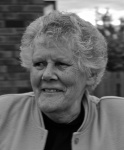
Inducted in 2008 for services to: Aboriginal or Torres Strait Islander affairs; Arts and media.
Born: 30 Oct 1937 {asset_metadata_roll.birth.in.on} Launceston, Tasmania
Passed: 2021
Phyllis Pitchford (Aunty Phyllis) was born at the Queen Victoria Hospital in Launceston in 1937, one of identical twins. After the birth, her mother returned to the family’s home on Cape Barren Island. When she was a young girl, Phyllis’s mother moved to mainland Tasmania and Phyllis and her five brothers then divided their time evenly between her father, who remained on Cape Barren Island, and her mother in Launceston. Phyllis remembers her childhood as a happy one, during which her parents helped her and her brothers maintain connections with their culture by involving them in traditional practises such as muttonbirding.
While in Launceston Phyllis attended Charles Street Primary School and Brooks High School, experiences she remembers fondly. After high school, Phyllis married a local man and moved to Flinders Island. Phyllis remembers a strong atmosphere of racism on Flinders Island, particularly during the 1980s, more so than she had experienced during her youth in Launceston and on Cape Barren Island. Despite this, Phyllis remained on Flinders Island. She raised five children and became extensively involved in the community.
For 35 years, Phyllis has been actively involved with, and worked for, the Tasmanian Aboriginal community. She is a respected Aboriginal Elder, mentor, poet and author. She is highly regarded as a passionate and proud advocate for Aboriginal people, their identity, culture and traditions.
Phyllis’s poetry and writing explores Aboriginal history, culture and identity. Many of Phyllis’s poems have been published, including Our Tally, If Only, Sad Memories and The First Xmas I Remember. One of her poems, We’re Here, is on exhibition at the National Museum of Australia. Phyllis has also written academic papers for state and national Aboriginal education programs and has been the Elder in Residence, a speaker and a Board Member for Riawunna, the University of Tasmania’s Centre for Aboriginal Education.
For the past 35 years, Phyllis has worked and served on boards and committees for a diverse range of Aboriginal organisations, often in a voluntary capacity. She was a founding member of the Flinders Island Aboriginal Association, the Babel Island Aboriginal Corporation and the Tasmanian Aboriginal Childcare Association and has been extensively involved with the Tasmanian Aboriginal Centre.
Also testament to the high regard in which Phyllis is held by the Tasmanian community is the government advisory roles in which she has served. These have included Phyllis’ membership of the Tasmanian Government State Strategic Planning Committee, the ya pulingina kani Indigenous Family Violence Working Group and the Tasmanian Women’s Consultative Council.
Phyllis has been a committed mentor for young Aboriginal people. She has been involved as an Elder and mentor in meenah mienne (my dream), an arts-based pilot project for Aboriginal youth in the justice system, and she visits and mentors young Aboriginal people in the Ashley Youth Detention Centre.
Phyllis has worked tirelessly for her community and has continued to work throughout mainland Tasmania on a wide range of issues including youth justice, childcare, education, housing, family violence and Aboriginal women’s health and wellbeing.
In 1992, Phyllis received a NAIDOC Award in recognition of her contribution to the communities of Tasmania, Flinders and Cape Barren Islands.